Mission and Objectives
Mission
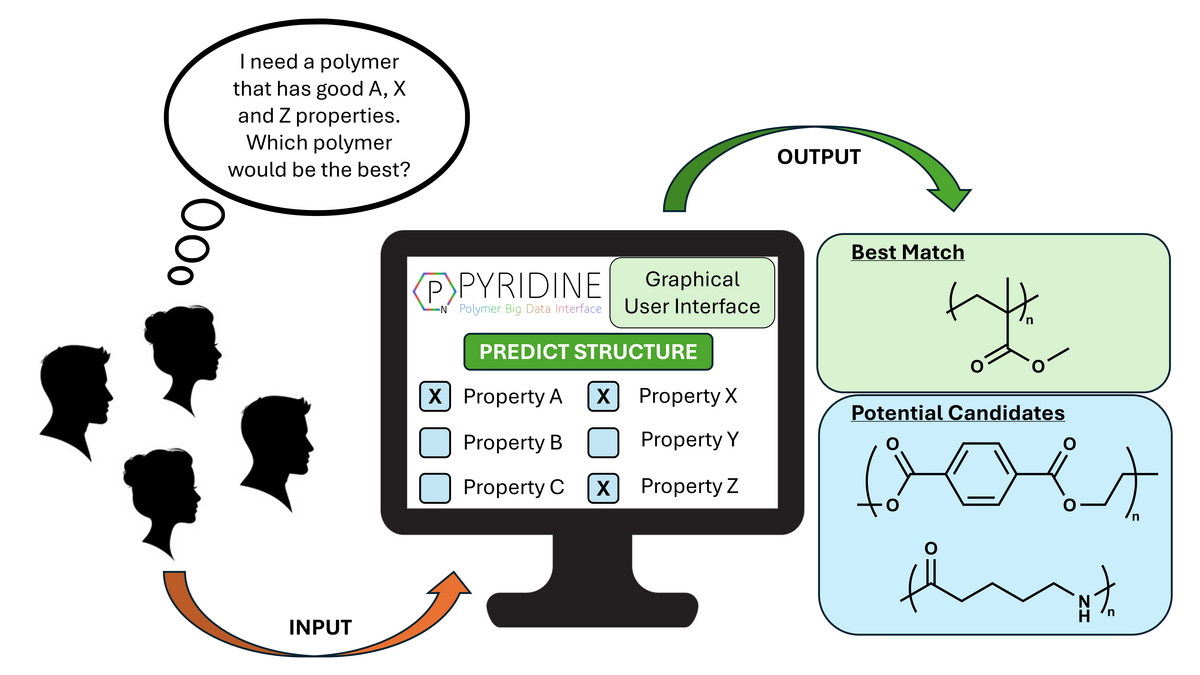
The PYRIDINE project mission is to open accessibility to skills of polymer scientists and engineers without the need to actually have any specific knowledge in that field, thanks to a simple graphical user interface that will allow users to specify the requested properties or performance for their applications and the artificial intelligence will provide the optimal materials structures (to purchase or to synthesize).
As such, the developed tool should facilitate and accelerate research and development of any industries or organisations working in the field of polymer science and engineering, in a similar manner as what is done in medicinal / pharmaceutical companies to accelerate the discovery of new drugs.
To reach this finality, the project has many aspects and objectives which are described below.
Objectives
Objective 1: Defining New Physico-Chemical Descriptors for Polymers

Prediction of any chemical structures requires the knowledge of parameters that relates the structure of a chemical with its properties. These parameters are called descriptors. While they are very well-defined for small organic molecules (like HOMO/LUMO energies, electronic affinity, electronic density, pKa, …), they are not suitable to describe polymers. Thus, there is a need to find new descriptors to represent polymers. One such example on which we have worked is chain flexibility which dictates most thermomechanical properties of polymers.
Objective 2: Characterizing the Relationships between Properties and Microstructures
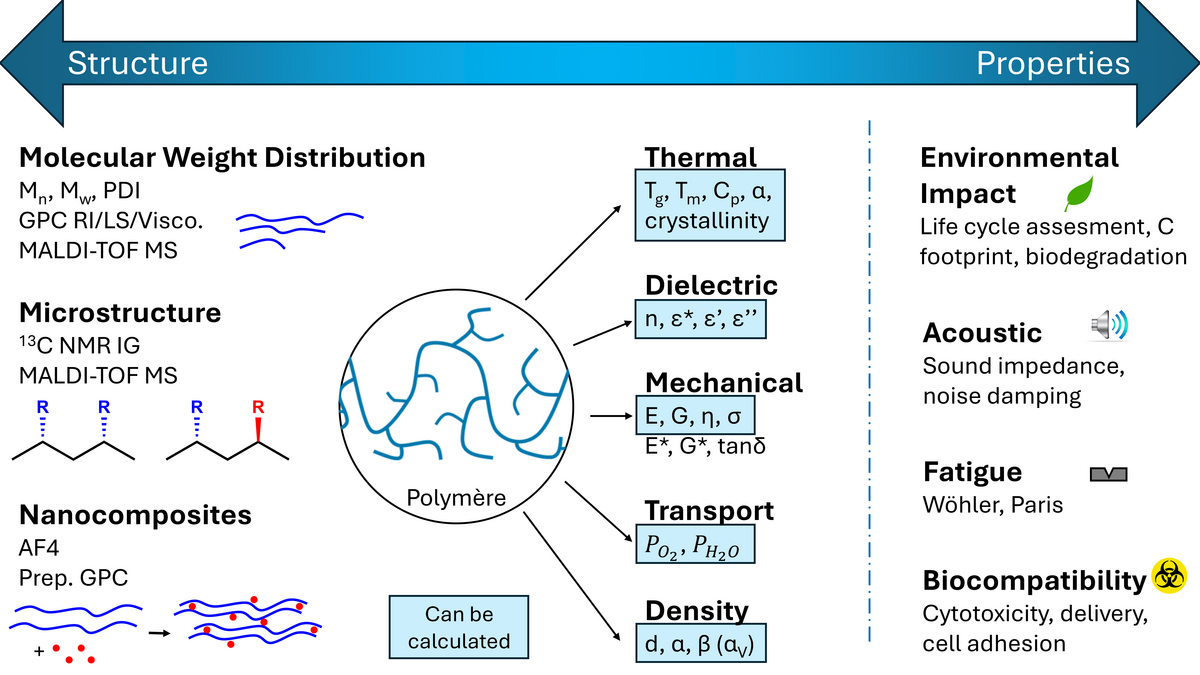
To develop useful new descriptors, it is crucial to know the exact microstructural information of a polymer (stereoregularity, tacticity, molecular weight distribution, branching, …). Most of the available data in the literature (including research articles, patents and existing databases) sorely lacks this microstructure information or are gathered all together according to the polymer name, so everything gets mixed up. However, this precise information makes drastic changes on a polymer properties. for example, atactic polypropylene (without stereoregularity) is completely amorphous, while isotactic polypropylene (with strong stereoregularity of its methyl side group) is semi-crystalline. With state-of-the-art instruments purchased thanks to the grant, will allow for this microstructure characterization.
Objective 3: Building a Massive Database Structured as Polymer Identification Files (PIF)
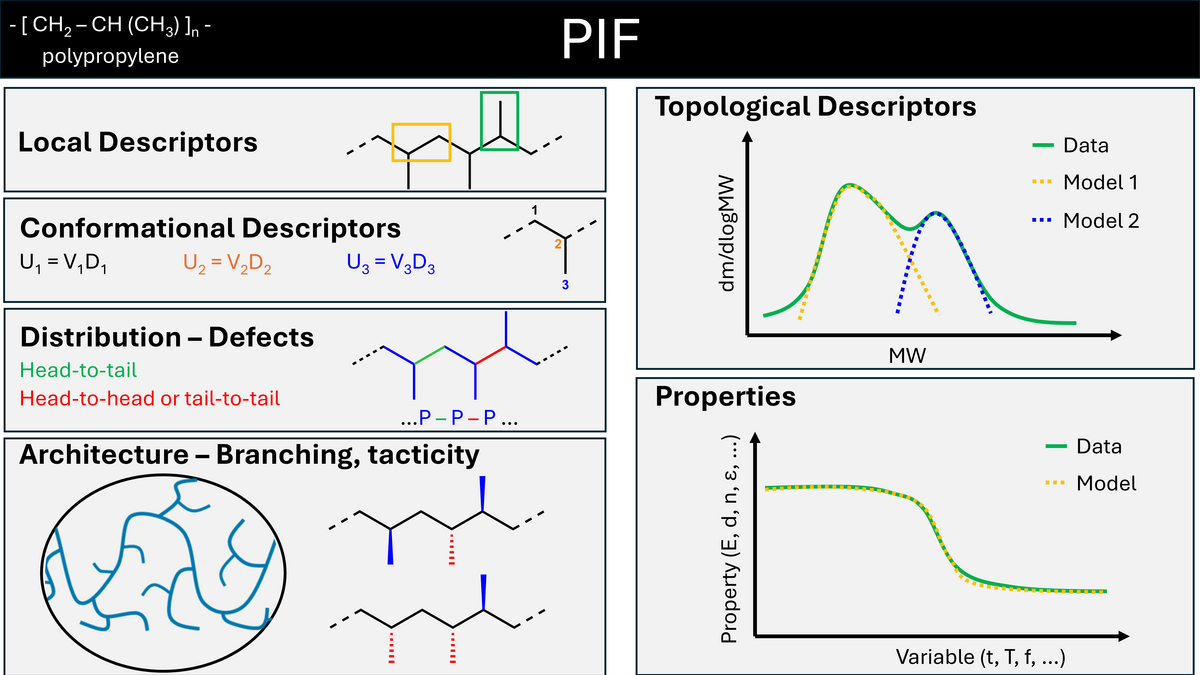
Once properties and microstructures have been accurately characterized, all that information will be stored in a massive database that will be populated not only from our lab-acquired data, but also with the available data from the literature. This database will then be used to train our artificial intelligence algorithms to design the backend of our graphical user interface tool. Of course, a variable statistical weight will be added on all data depending on their completeness to avoid putting false biases on our algorithms. Note that the database will remain the property of the PYRIDINE project and its data will not be directly accessible to the community, as opposed to our graphical user interface tool.
Objective 4: Developing the User Graphical Interface (GUI) Tool
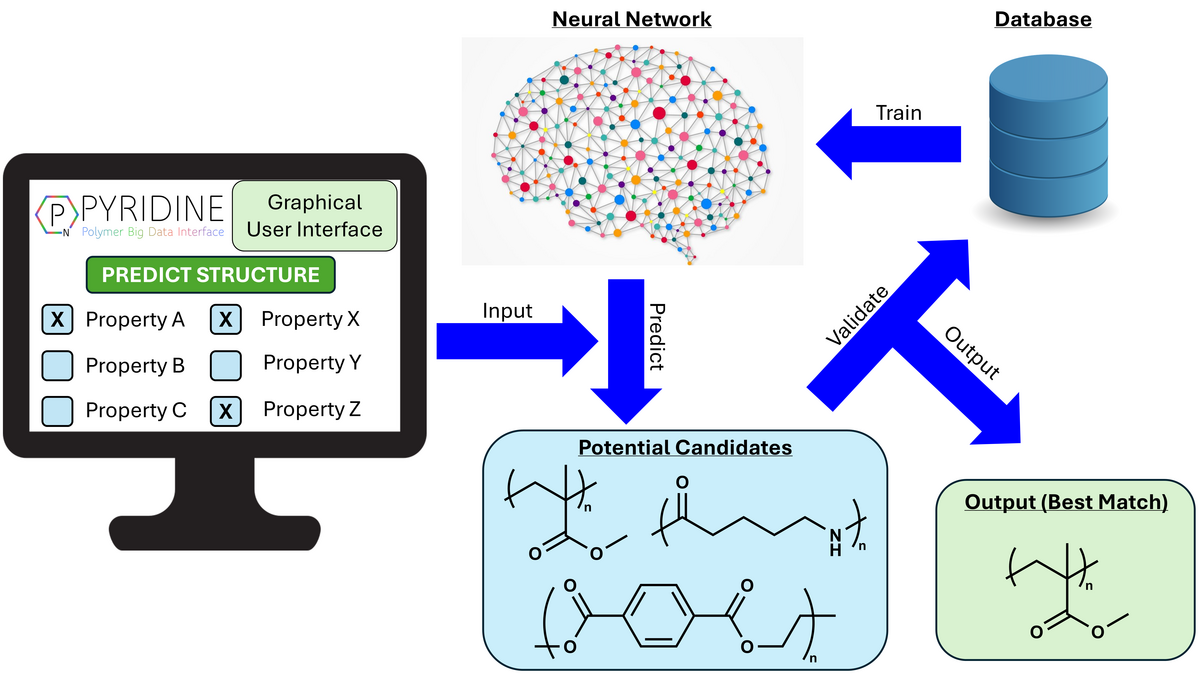
To allow an easy use of our algorithms, they will be programmed behind a graphical user interface in which the user will only need to specify the required properties or performances, then at the click of a button, our algorithms will do their work and predict the optimal polymer accordingly. This GUI will be accessible by the community with restricted or limited access, then user licenses will be sold at reasonable price to unlock the full potential of our tool.